Choosing A Rat
When a beginner, it is best to
have only one sex of rat in the house, unless the rats have
been altered. It is easier to free range, and it eliminates
any accidental pregnancies from happening. It only takes a
couple of seconds for an accident to occur, and
unfortunately accidents are fairly common.
As far as which sex is concerned, it is an individual
preference. Female rats are smaller, their coats softer, and
they normally scent mark their territories less. They are
also extremely active throughout their lives, and rarely sit
still on their owners laps, preferring to be out and
exploring. Males are far more laid back on a whole, grow
much bigger in some cases, and are more likely to be ‘lap’
rats. Their coats are usually coarser, and they can scent
mark quite a bit. They have very pronounced testicles, which
can sometimes turn people away.
Of course, this is only a generalization, some rats will
be the complete opposite. They are all individuals with
their own distinct personalities.
When deciding upon which type of rat to get, the choices
are abundant. There are standard eared, and dumbo eared,
standard coat, rex coat (curly with curly whiskers),
patchwork or semi hairless, and hairless rats. Hairless rats
do need some special treatment, so are not a wise choice for
beginners. Rats come in a rainbow of different colours and
with different markings. There are self's (all one colour),
hooded, capped, Berkshire, Irish, blazed, and many more
markings, in all colours ranging from black, white, blue,
beige, Siamese, agouti and everything in between. There are
nearly as many colours and markings of rats than there are
cats.
For more examples, or for pictures of each, please visit
the following websites:
www.ratbreeding.com/Coat_Color_Photos.htm
www.altpet.net/rodents/rats/rf03.html
mutantspud.com/frc/info_pages/about/markings_colors.html
www.rmca.org/Standard/Rat/ratidx.htm
www.afrma.org/fancyrm.htm
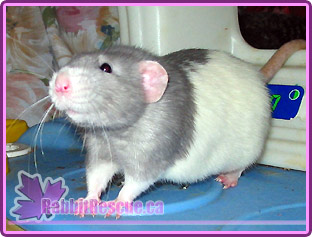
When you are choosing a particular rat there are a number
of things to watch out for. You want to chose a rat that is
active and seems curious. Your rat should have no pink/red
staining around the nose and eyes. This staining is called
porphyrin and could indicate that the rat is not well. Their
eyes should be big and wide, their coats should look healthy
and shiny and their skin free of scabs or bald patches
(unless the breed is a patchwork or semi hairless). Your rat
should not be fearful of you, and should be eager to be
picked up. A rat that runs and hides, or squeaks or
struggles when picked up could be a less socialized rat and
will require special handling until the rat is comfortable
with humans.
Their breathing should be very quiet. Be sure to hold the
rats chest up to your ears. All you should hear is their
heart beating and maybe a slight breathing sound. If what
you hear is a raspiness, or congested chest, the rat could
have a respiratory infection that should be taken care of
before they are adopted out. They should not be sneezing, or
making clucking sounds when they breath. Their teeth should
be straight and their noses clean.
Housing
Rat owners have several options for
housing their rats. The most important part of housing is
that the rats have enough room. Each rat requires a minimum
of 1.0 cubic feet within the cage, with 2.0 cubic feet per
rat being ideal for an animal their size. If rats feel
cramped they will fight and behave aggressively towards one
another. Overcrowding makes for unhappy rats. There are cage
calculators available to test to see how many rats are able
to fit inside your cage. The calculators can be found here:
http://www.kristinewickstrom.homestead.com/files
/PanelApplet.html
http://www.rattycorner.com/odds/calc.shtml
Although others have found glass or plastic aquariums
acceptable, they are not always the best choice. Aquariums
work well in areas that are drafty, or for sick or nursing
rats. Aquariums keep heat in efficiently, and provide a safe
environment for rats small enough to fit through cage bars.
Never keep aquariums in direct sunlight.
Aquariums are also very inexpensive. Rat owners can find
second hand glass aquariums sometimes very cheaply due to
the fact that they no longer are able to hold water.
Aquariums need to be cleaned out completely every couple
of days because the ammonia from the rat urine builds up
quickly and causes the rat respiratory distress. It is very
challenging to find items that can go into the aquarium that
need to be elevated as well.
Cages are looked upon as the better option for the
following reasons. Cages provide constant air exchange that
does not allow the ammonia to build up within. They are
easier to clean in that they can be wiped down much of the
time with a non-toxic, animal friendly product instead of
being completely submersed in water. Attaching water bottles
and hammocks are easy with a metal cage. When choosing a
metal cage, it is better to go with powder coated as opposed
to galvanized. Powder coated are much easier to clean, and do
not smell as the galvanized tend to do with time.
Most metal cages come with plastic, or metal bottoms.
Both are fine as they are covered with shavings or cloth for
the comfort of the rats. The bottom of the cage must never
be wire, always a solid bottom. A rats foot can easily be
damaged between the wire bars along the bottom of the cage.
The most common problem with metal cages are that they
are expensive for rats due to their size requirements. Many
use cages designed for ferrets because they will house
multiple rats in one cage. They can also be awkward to clean
when the shelving inside cannot be removed.
Where cages are kept is also important. They should not
be in a drafty area, or in direct sunlight.
Different types of metal cages can be found here:
www.martinscages.com
www.petsmart.com

| Donate Today! |
|
|
|
Just click on a button to the left to make a secure
donation. Tax receipts will be provide to you for your donation.
Sponsor a rat today and help save a life! |
|
BeddingThere are many options that can
be used for rat bedding. Pine and cedar ARE NOT two
of them. Pine and cedar woods contain phenols, which are
natures insecticide, and phenols are what gives the wood the
favorable smell. However, they are deadly for small
animals, especially for those with sensitive respiratory
systems. They also release hydro carbons which can cause
respiratory problems and liver damage in small animals.
The only acceptable wood shavings are made from Aspen.
Safe rat bedding includes Wood stove pellets, and paper
based products such as Yesterday’s News or Care fresh.
Care fresh can be dusty, irritating sensitive rat
respiration. Yesterdays News (compressed newspaper pellets)
will break down less that Wood Pellets when in contact with
urine, (causing piles of dust to develop).
Towels are also very popular. Towel bedding does require
changing frequently, every day or two, due to the buildup of
rat urine. When washing any cloth bedding, it is suggested
to use non perfumed detergent and fabric softener.
Other items commonly used are hemp, wood stove pellets
and rabbit food, or alfalfa pellets. Rats will not eat
alfalfa, so using it as a bedding is safe.
Many rat owners will use a combination of the above,
shavings at the bottom of the cage, and cloth as hammocks or
to line shelves for ratty comfort.
It is important that a rats environment be kept very
clean. If the smell of pine and cedar are appealing in order
to keep the smell down, the cage is not being cleaned
frequently enough. A well maintained rat cage should have
very little smell to it. It should not require masking by
using dangerous aromatic wood bedding.
Cage Acessories/Toys
Due to their high intelligence,
rats need to be intellectually stimulated in addition to
physically stimulated. When they are not out free ranging and
playing with their humans, they should be provided with toys
and entertainment within their cage. There are also many
ways to entertain your rats, and keep them happy, while they
are out of the cage. Toys can include digging boxes,
rattles, ramps, chew toys, etc.A very good website that
lists lots of entertaining and inexpensive ideas can be
found here:
http://www.dapper.com.au/toys.htm
Nutrition
Rats are omnivores,
insectivores, and scavengers. In the wild, they will eat
almost anything to survive. However, their lives are
shortened because they do not get the proper nutrition that
they require. It is very important that pet rats have all
their nutritional needs provided to live long and healthy
lives.Rat diets should consist of
the same items as a human diet. Those foods that are not
healthy for humans to eat, should not be given to rats
either. Sweets and treats should be given in moderation as
rats are notorious for having a sweet tooth.
Rat blocks, or lab blocks are designed to
provide all the necessary nutritional requirements. They are
also designed so the rat will not eat just the favourite
pieces and leave the rest. Seed mixes are not ideal for this
reason. The rats will eat the fattening nuts and leave the
bits that they need the most.
Another staple that is frequently used is
Nutro Natural Lite Dog food. Because dogs are also
omnivores, their kibble is an acceptable substitute for lab
blocks designed for rodents. For more info, visit:
http://www.epetpals.com/cgi-bin/commerce.exe?preadd=action&key=079105206006
One of the most important things to check
for when picking a stable block or kibble for your rat is
the protein levels. Male rats should not get more than aprox
18% protein in their diets. Females or nursing mothers
should receive more protein, but should not get more than
about 25%. When rats have too much protein in their diets,
they can suffer from very uncomfortable and itchy skin
conditions. They will scratch themselves constantly causing
hair loss and scabs.
Rats cannot live on their staple food
alone. Be sure to substitute frequently with fresh fruits
and vegetables, with a treat of meat or chicken thrown in
occasionally. Store bought treats should be kept to a
minimum, instead use cereal, or the rats favorite fruit or
vegetable. Peas are usually a favorite of every rat.
Be aware that there are a handful of foods
that should not be fed to rats. A list of forbidden foods,
or foods to give with caution can be found here:
http://www.ratfanclub.org/diet.html
(scroll down about ¾ of the page)

Health
Rats can suffer from many
medical conditions. The most common are respiratory
diseases, and tumours in females. It is very important that
a new rat owner already has a vet lined up that is familiar
with treating rats, and not be caught with a sick rat and
nobody to treat it.
Not all vets will treat rats, and many others are not
very knowledgeable with their specific health issues and
current successful treatments. Please do not assume that a
vet that treats cats and dogs will see rats. Do some
research on area vets, and their prices & experience with
them. How many rats do they see each week? Rats are
considered ‘small exotics’ by many vet practices.
Some excellent links on rat ailments, care and
medications can be found here:
www.ratguide.com
www.nenuphar.plus.com/FirstAid
www.raisinrats.com/medicalinfo.html
www.rmca.org/Articles/dchart.htm
This last one is very important, and all rat owners
should be familiar with the treatments it outlines. It is
strongly suggested by many rat owners that it is printed out
and brought to the vet along with the rat in order for the
owner to discuss with the vet the best course of treatment.
Further Reading
Rats Complete Care
Book -
Author: Debbie Ducommun
Rats! -
Author: Debbie Ducommun
Health Care Booklet -
Author: Debbie Ducommun
Barron's Fancy Rats -
Author: Gisela Bulla
The Rat
An Owner's Guide to a Happy, Healthy
Pet - Author:
Ginger Cardinal
|


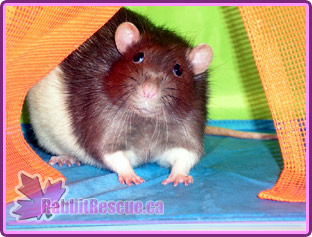 Rats are extremely intelligent
creatures. It is often said that they have the intelligence
level of a two and a half year old child. Contrary to popular
belief, they are also very clean animals. Rats groom themselves
over seven times a day, from the tip of their nose, to the tip
of their tail. They also frequently groom each other, but as
more of a social gesture.
Rats are extremely intelligent
creatures. It is often said that they have the intelligence
level of a two and a half year old child. Contrary to popular
belief, they are also very clean animals. Rats groom themselves
over seven times a day, from the tip of their nose, to the tip
of their tail. They also frequently groom each other, but as
more of a social gesture. While rats tend to be less expensive to purchase/adopt,
realize that their supplies, medical care etc can add up! While
their housing is not too expensive, their medical bills can be
high, and just like any other animal, they must go to the vet
when ill.
While rats tend to be less expensive to purchase/adopt,
realize that their supplies, medical care etc can add up! While
their housing is not too expensive, their medical bills can be
high, and just like any other animal, they must go to the vet
when ill.
